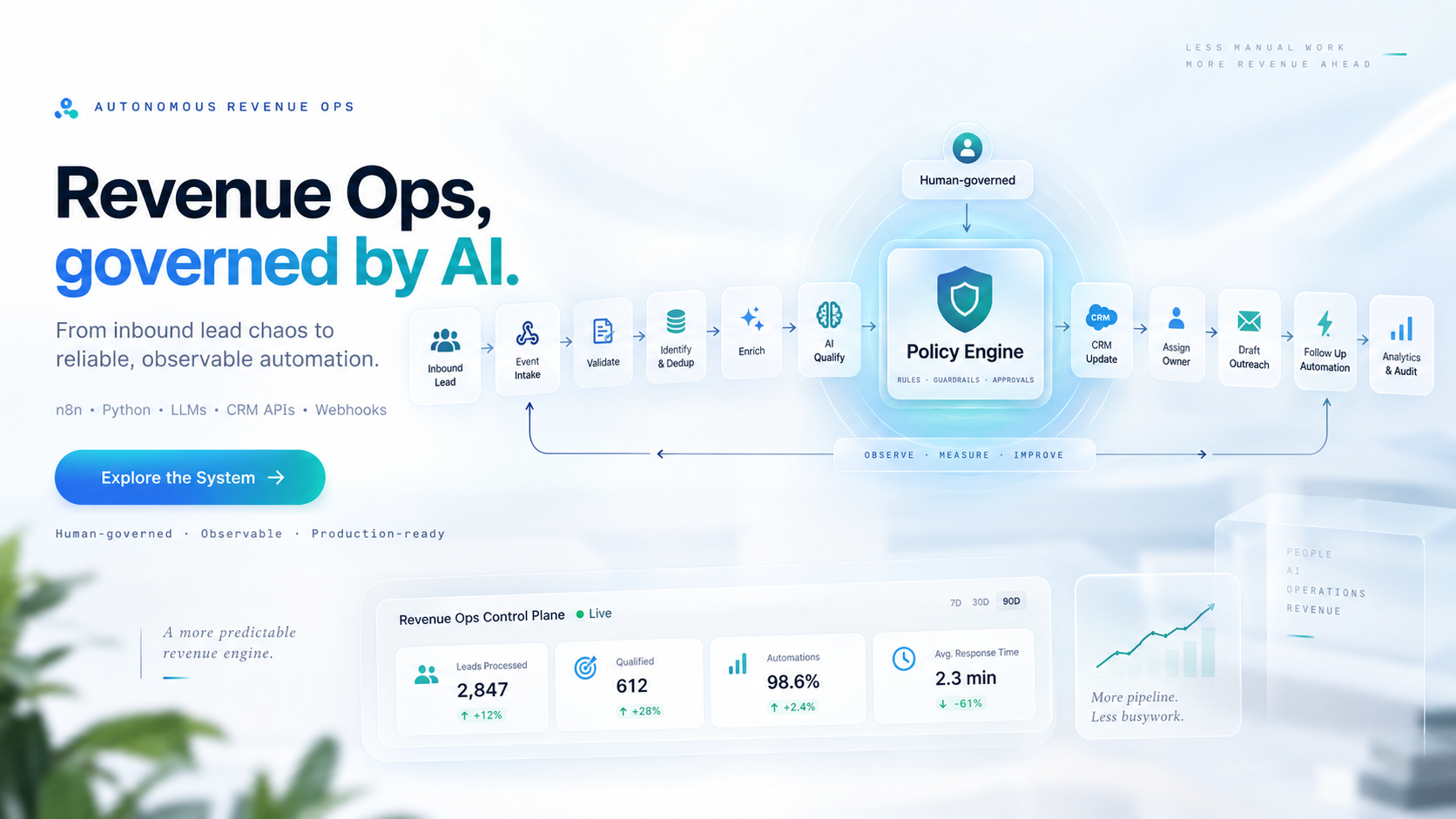
AI judgment
Research, qualification and outreach agents produce structured proposals and evidence.
A production-oriented reference implementation for revenue automation where AI contributes research, qualification and outreach judgment without owning authorization, durable state or uncontrolled side effects. The system combines multi-model agents, deterministic policy, restart-safe orchestration, SaaS adapters, release engineering and operational evidence.
An LLM can classify a lead and draft an email in seconds. The difficult engineering starts when the workflow receives duplicates, malformed input, low-confidence output, stale state, provider errors, approval cases, rate limits and actions with real business consequences. I built this project to make those boundaries explicit: the model proposes; deterministic software decides what is allowed; durable workflow state determines what can execute; and retained evidence supports each maturity claim.
Lead / signed webhook / n8n
          ↓
Authentication + typed validation
          ↓
Correlation + DB-backed idempotency
          ↓
Durable workflow run
          ↓
Research Agent → Qualification Agent
          ↓
Structured-output validation
          ↓
Deterministic policy
   ↙          ↓           ↓           ↘
AUTO_ROUTE  HUMAN_REVIEW  RESEARCH_MORE  BLOCK
   ↓          ↓           ↓             ↓
READY       checkpoint   checkpoint    complete
   ↓          ↓           └──→ research
   └──────────┘
          ↓
Outreach Agent
          ↓
Execution claim / lease
          ↓
HubSpot · Salesforce · Slack · SMTP · Webhook
          ↓
Retry · Circuit Breaker · DLQ · Replay
          ↓
Execution receipt
          ↓
Measured runtime analytics + retained evidenceResearch, qualification and outreach agents produce structured proposals and evidence.
Deterministic policy decides AUTO_ROUTE, HUMAN_REVIEW, RESEARCH_MORE, NURTURE or BLOCK.
Durable orchestration, revisions, idempotency, leases, checkpoints and execution receipts live outside the LLM.
HubSpot, Salesforce, Slack, SMTP and webhook adapters execute only after policy and workflow authorization.
Retries, circuit breaker, DLQ, replay and recovery paths make failure explicit rather than exceptional.
API-key boundary, signed webhooks, replay protection, secret-safe evidence and hardened container/runtime controls.
Frozen deterministic cases, prompt manifests, release gates and retained external-validation contracts.
Measured runtime aggregates, Prometheus-compatible metrics and reviewer-facing dashboard surfaces.
The 100% deterministic agent result is controlled contract/governance evidence, not a claim that OpenAI, Anthropic or Gemini have 100% real-world accuracy. Live provider and SaaS execution remains a separate retained-evidence step.
Portfolio case study → GitHub architecture → Hugging Face demo
→ Streamlit Operations Center → n8n workflow → Postman API
→ Grafana telemetry → CI / release evidence → retained live validation
The current system is release-integrity controlled, contract-tested, restart-safe, security-hardened and single-replica by design. It is not yet Production Validated. Real provider/SaaS/staging runs must be executed through the retained-evidence workflow, long-window SLO evidence must be collected, and the SQLite persistence boundary must move to a shared transactional backend before horizontal-replica claims are made.
Architecture, typed API, tests, CI, release controls, n8n, Postman, Grafana and deployment assets.
Open ↗Interactive policy and system demonstration.
Open ↗Public regression/evaluation cases used to keep behavior inspectable.
Open ↗Intended use, limitations and evidence boundaries.
Open ↗Fast reviewer path through architecture, controls and verified evidence.
Open ↗This project is less about replacing revenue teams with an agent and more about engineering a trustworthy control plane: bounded AI judgment, explicit policy, durable state, recoverable execution, observable outcomes and evidence-linked releases.