Why Revenue Automation Needs a Control Plane, Not Just an AI Agent
A production revenue-operations system needs more than lead scoring and message generation: deterministic authorization, durable workflow state, recoverable execution, evaluation, release evidence and operational telemetry.
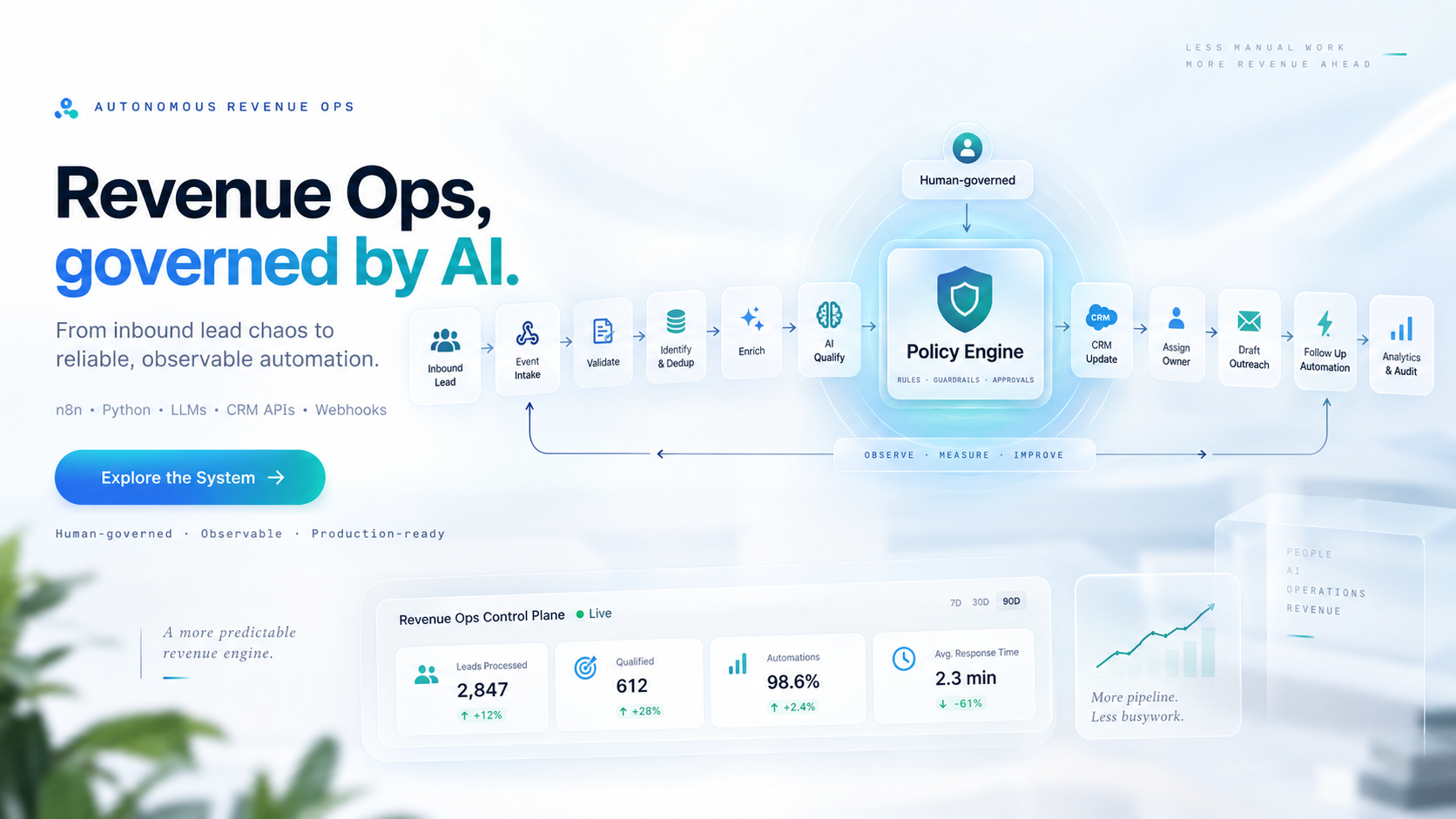
It is easy to build an impressive revenue-automation demo.
A form submission arrives. An LLM classifies the lead as hot, warm or cold. The workflow creates a CRM record, sends a message and alerts sales. In a controlled demonstration, that can look autonomous.
The production question is harder:
What happens when the same lead arrives twice, the model is uncertain, the CRM returns a rate limit, a workflow restarts halfway through execution, a human needs to approve the action, or a new model version changes behavior?
That is the gap I wanted to explore with Autonomous Revenue Ops.
The project is not primarily about making an agent more persuasive. It is about engineering the system around the agent so AI can contribute useful judgment without becoming the source of authorization, state or uncontrolled side effects.
The core rule
The architecture follows one simple principle:
AI may propose. Software validates. Policy authorizes. Durable workflow state gates execution. Bounded adapters act. Evidence determines completion.
That changes how the system is designed.
The research and qualification agents can produce structured evidence, a score, confidence, risk flags and an outreach draft. But they do not decide whether the CRM should be changed or a message should be sent.
A deterministic policy layer makes that decision.
The workflow can resolve to:
AUTO_ROUTEfor clearly authorized high-confidence cases;HUMAN_REVIEWwhen judgment or risk requires an explicit checkpoint;RESEARCH_MOREwhen confidence is too low;NURTUREfor lower-priority permitted cases;BLOCKwhen policy says the system must not act.
This distinction matters because model output is probabilistic while business authorization should be inspectable and testable.
Workflow state should not live inside the conversation
Another important design decision is to keep durable workflow state outside the LLM.
The system persists workflow runs, revisions, idempotency keys, approval checkpoints, execution claims, leases, recovery state and final receipts. That allows the workflow to answer questions a conversational agent cannot reliably answer on its own:
- Has this lead already been processed?
- Is another worker currently executing the side effect?
- Was this action approved by a human?
- Did the CRM update actually succeed?
- Is this a retry or a new request?
- Can this run be safely resumed after a restart?
The model provides judgment. The workflow engine provides operational truth.
Failure is part of the architecture
Revenue systems interact with services that fail in ordinary ways: timeouts, HTTP 429 responses, expired credentials, malformed payloads and partial downstream success.
So the project treats failure as a first-class state rather than an exception around a happy path.
The control plane includes:
- retry and backoff behavior;
- circuit breaking;
- a persistent dead-letter path;
- replay and recovery;
- stale-writer protection;
- execution receipts;
- signed and replay-protected webhook ingress.
This is one of the biggest differences between a workflow that can run and a workflow that can be operated.
AI evaluation belongs in the release process
A production system also needs a way to answer a different question:
Did the new model, prompt or policy change make the system better or just different?
Autonomous Revenue Ops therefore separates deterministic release evidence from live-provider evaluation.
The CI path runs frozen regression cases, policy benchmarks, structured-output checks and agent-level release gates. Prompt versions are tracked through a manifest. Provider smoke tests remain side-effect-free by default.
Real model-provider, SaaS and deployment validation is manual and retained separately. A live evidence bundle is tied to the exact source commit, service version, prompt manifest, evaluation dataset and release manifest.
This avoids a common portfolio problem where a one-time external API call is silently presented as evidence for the whole system.
Operational evidence should not become invented ROI
The system exposes aggregate workflow analytics and Prometheus-compatible metrics:
- workflow-state counts;
- policy-decision counts;
- completion and failure ratios;
- human-review and additional-research ratios;
- authorization and recovery ratios;
- execution-receipt ratio;
- average and P95 recorded workflow lifecycle duration.
These are labeled measured_runtime because they come from persisted workflow records.
Business-impact calculations are kept separately as scenario_projection. They can help estimate potential capacity or cost effects, but they are not presented as measured customer ROI.
That distinction is small in code and important in engineering credibility.
One project, multiple proof surfaces
I do not think a single live demo is enough to communicate a system like this.
Different surfaces prove different things:
- GitHub shows source, tests, architecture, ADRs, CI and release controls.
- Hugging Face Space provides an interactive public system/policy demonstration.
- Hugging Face Dataset exposes evaluation data.
- The system card explains intended use and limitations.
- Streamlit is the reviewer-facing operations console.
- n8n makes the trigger and orchestration path visually inspectable.
- Postman provides a forkable API surface.
- Grafana provides operational telemetry.
- A staging FastAPI deployment makes health, OpenAPI and workflow behavior inspectable against a real runtime.
The important point is that these are not separate implementations. They all point to the same governed control plane.
What is still not claimed
The repository has strong production-candidate evidence, but I deliberately do not call it fully production validated yet.
The remaining evidence includes real retained provider/SaaS/staging runs, longer observation windows for SLOs, and migration from SQLite to shared transactional persistence before horizontal-replica claims.
That boundary is intentional.
In AI engineering, credibility is not only about showing what works. It is also about being precise about what has actually been proved.
Engineering takeaway
The useful question is not:
“Can an AI agent automate revenue operations?”
The better question is:
“Can we make its judgment bounded, its actions authorized, its state recoverable, its releases testable and its outcomes observable?”
That is the difference between an agent demo and an operational system.
Explore the project:
Hendar Mawan is an AI engineering leader working across production AI, Edge AI, secure AI infrastructure, platform architecture and R&D leadership.
Back to portfolio →