Why Agent Demos Fail in Production
Why impressive agent demos often break under real production conditions—and what changes when reliability, permissions, evaluation, observability and recovery become engineering requirements.
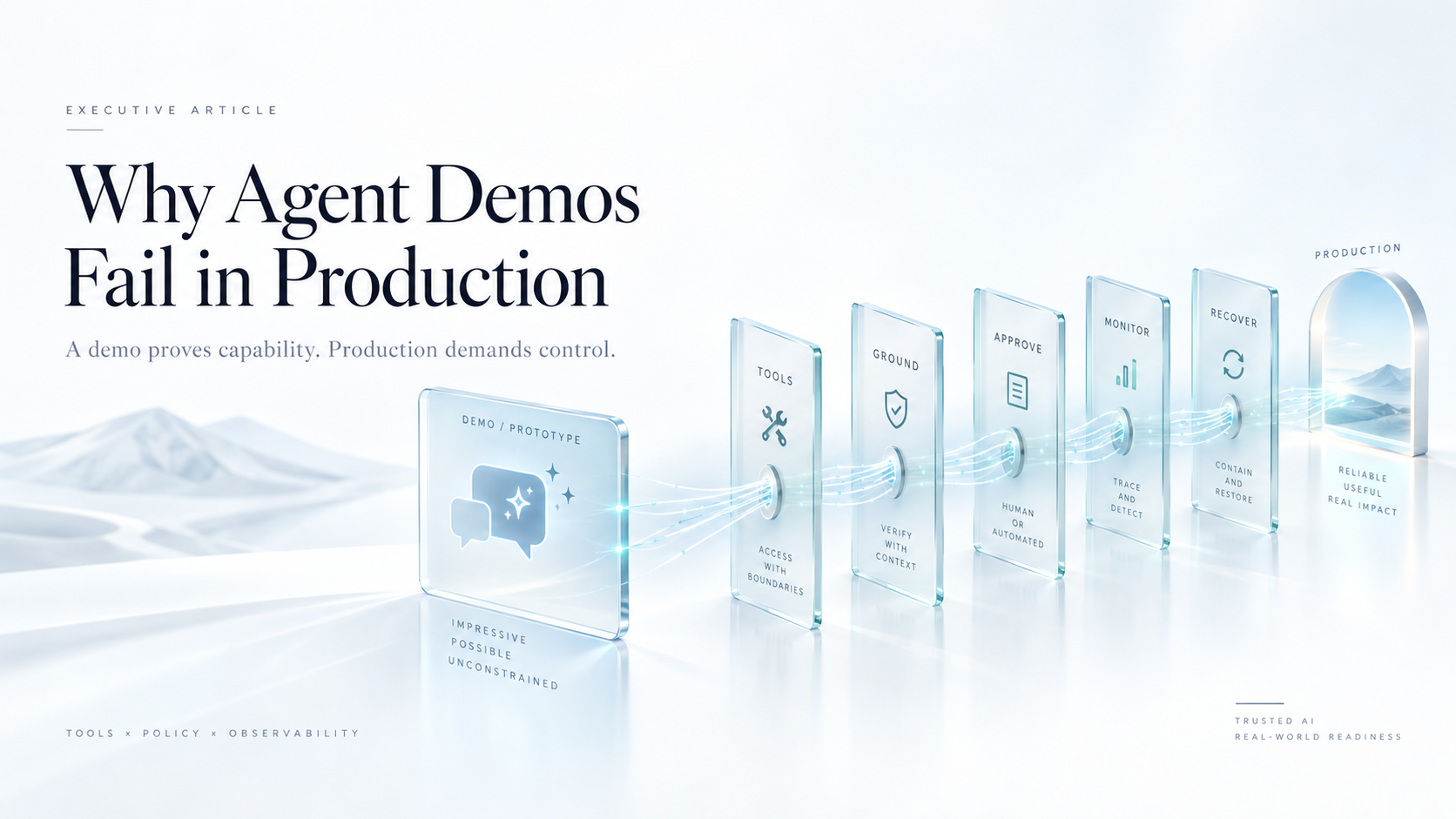
Agent demos are optimized to prove that something can work. Production systems have to prove that they can work reliably, safely and repeatedly under conditions the demo never showed.
That gap is where many agent projects fail.
A prototype may look impressive when an LLM plans a task, calls a tool and returns the right answer. But real deployment introduces noisy inputs, ambiguous instructions, changing data, tool failures, permission boundaries, prompt injection, latency, cost constraints and actions with real consequences.
Capability is only one layer
The model may provide reasoning and language capability, but production behavior depends on the system around it:
- tool routing — does the agent choose the correct tool and parameters?
- grounding — are claims supported by trustworthy evidence?
- permissions — can the agent act only within explicitly authorized boundaries?
- policy enforcement — are unsafe or prohibited actions blocked before execution?
- evaluation — are failures measured across realistic tasks and adversarial cases?
- observability — can teams reconstruct what the agent did and why?
- recovery — can bad actions, regressions or failed releases be contained quickly?
This is why a successful demo is not yet evidence of production readiness.
Production exposes hidden failure modes
The hard failures often appear outside the happy path: a tool returns malformed data, retrieved content contains hostile instructions, a model update changes routing behavior, a workflow exceeds its latency budget, or an agent attempts an action that should require human approval.
These are not edge concerns. They are part of the operating environment.
A production-grade agent therefore needs more than a prompt and tool list. It needs an explicit control plane around the model: permissions, policy checks, evaluation gates, structured traces, monitoring, approval boundaries and rollback mechanisms.
The engineering shift
The important transition is from asking:
“Can the agent complete this task?”
…to asking:
“Can we bound, measure, observe and recover this behavior when the environment changes?”
That shift turns an agent from a persuasive prototype into an engineered system.
The demo proves capability. Production requires control.
This short post summarizes the core idea behind “Why Agent Demos Fail in Production”: the biggest gap is usually not model intelligence, but the missing engineering around reliability, security, evaluation, permissions, observability and recovery.
Hendar Mawan is an AI engineering leader working across production AI, Edge AI, secure AI infrastructure, platform architecture and R&D leadership.
Back to portfolio →