Agentic AI Academy: Engineering Trustworthy AI Agents from Learning to Production
An open-source engineering pathway for learning how to design, build, evaluate, secure, operate, govern and scale AI agents from first implementation to production release control.
EXPLORE · IMPLEMENT · SCALE
AI agents are easy to demonstrate and much harder to engineer for production.
A prototype can call a tool, retrieve information, generate a convincing answer and look complete. A production agent must do more: operate within explicit permissions, handle imperfect data and tool failures, preserve evidence, resist unsafe instructions, expose traces, meet latency and cost constraints, and stop safely when confidence or policy conditions are not satisfied.
That gap is the reason I built Agentic AI Academy.
The Academy is an open-source curriculum, engineering laboratory, reference architecture and professional portfolio for learning how to design, build, evaluate, secure, operate, govern and scale AI agents.
It is deliberately not a collection of chatbot tutorials. The core idea is to treat agentic AI as a systems-engineering discipline where capability must be paired with measurable reliability, bounded autonomy, evaluation, observability, security, governance and safe failure behavior.
From learning an agent to operating one
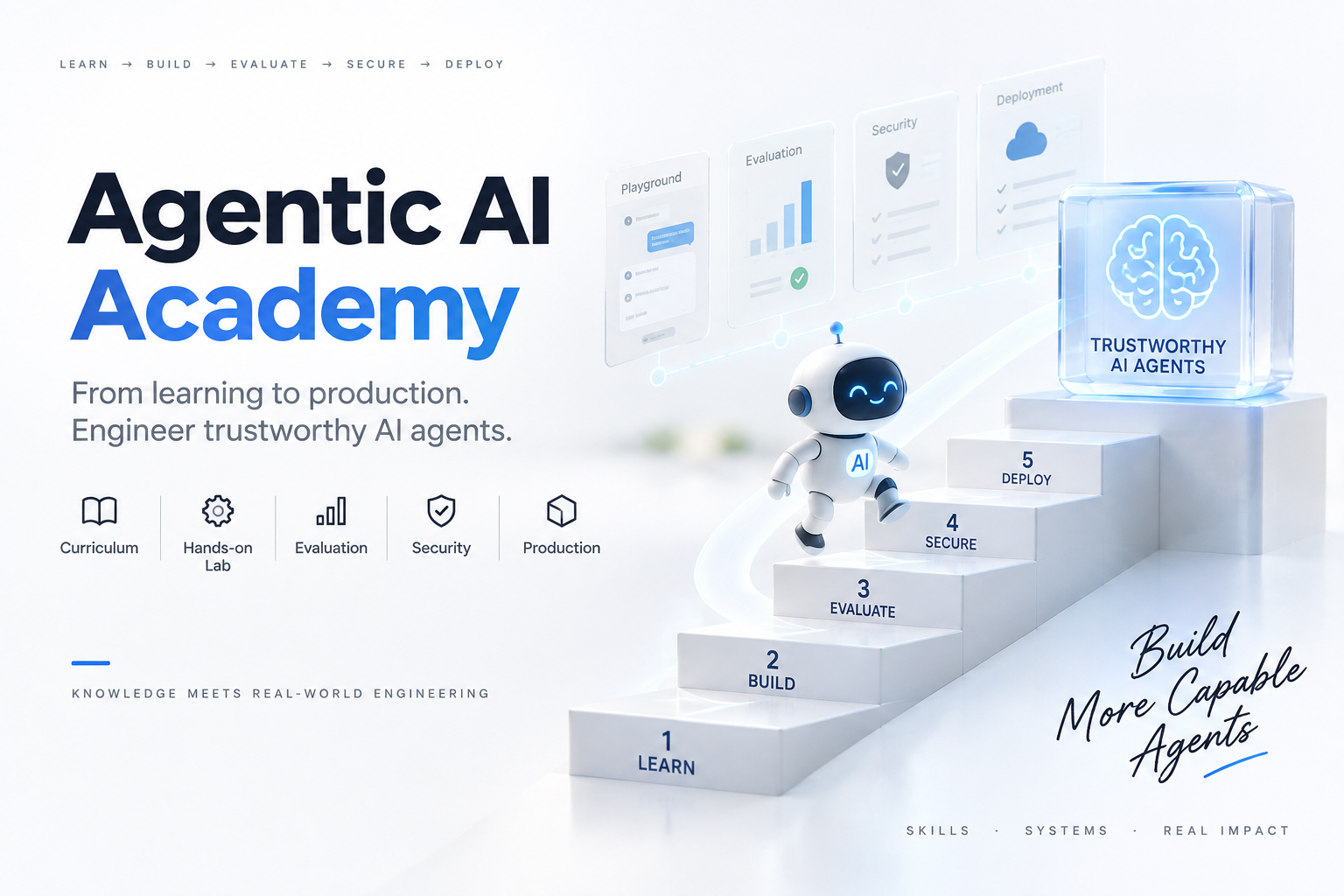
The Academy organizes the journey around a simple progression:
curriculum → implementation → dataset → evaluation → interactive demo → release gate → production engineering
That sequence matters.
Learning how an agent loop works is useful, but production confidence comes from connecting implementation to evidence. The agent needs a benchmark. The benchmark needs repeatable evaluation. Evaluation needs traces and failure analysis. Release decisions need explicit thresholds. Production then needs observability, policy enforcement, rollback and operational evidence.
The result is a learning environment that connects concepts directly to engineering practice.
A 14-module systems-engineering curriculum
The curriculum moves from foundations to production architecture across 14 modules.
It covers:
- Agentic AI foundations and opportunity assessment
- Python for agent engineering
- LLM and agent fundamentals
- Single-agent loops and state
- Tools, APIs and MCP
- RAG, knowledge and memory
- Multi-agent coordination
- Agent evaluation
- Security and safety
- Production agent engineering
- Observability and operations
- Governance, risk and scaling
- Enterprise agentic AI architecture
- AI engineering leadership and strategy
The intent is not simply to teach frameworks. It is to teach the engineering questions behind them: when should an agent act, what is it allowed to do, how do we know whether it succeeded, what can go wrong, and how do we recover when it does?
The public engineering stack
The Academy is published through several connected engineering surfaces, each with a different role.
Hugging Face Playground — experience the agent
The Agentic AI Playground provides an accessible live surface for interacting with bounded agent behavior, tool use, retrieval and policy decisions.
Try the Agentic AI Playground →
Hugging Face Dataset — benchmark the agent
The public Evaluation & Security Benchmark turns expected behavior into reusable test cases. It gives the system something concrete to measure instead of relying on impressive individual conversations.
The benchmark covers areas such as task success, tool routing, groundedness, prompt injection, unsafe actions, policy behavior and regression cases.
View the Evaluation & Security Benchmark →
Streamlit Engineering Lab — inspect and operate the agent
The Agentic AI Engineering Lab is the operational layer.
It brings together benchmark execution, traces, RAG evidence, security failures, regression comparison, latency and cost signals, release thresholds and downloadable reports.
That changes the question from:
“Did the agent answer correctly?”
into:
“Can we inspect why it behaved this way, compare it with a baseline, detect regressions and decide whether the system is ready to release?”
Open the Agentic AI Engineering Lab →
Model Quality Release Gate — turn evidence into a decision
Evaluation alone is not release engineering.
The Model Quality Release Gate connects baseline-versus-candidate evaluation to an explicit production decision:
SHIP · INVESTIGATE · HOLD
Critical safety, correctness or reliability failures remain blockers even when aggregate model quality improves. This separates evidence collection from release authority and makes promotion decisions reproducible.
Explore the Model Quality Release Gate →
View the Release Gate Dataset →
What production-grade agent engineering changes
A useful production agent needs more than reasoning capability.
It needs an architecture around the model.
That architecture should define:
- Tool boundaries — which actions exist and what parameters are valid?
- Permissions — what may the agent read, write or execute?
- Grounding — what evidence supports a generated claim?
- Evaluation — how is success measured across realistic and adversarial cases?
- Security — what happens under prompt injection, hostile retrieval or unsafe tool requests?
- Observability — can the trajectory, tool calls and failure state be reconstructed?
- Human approval — which actions require accountable intervention?
- Release policy — what evidence is required before a candidate progresses?
- Recovery — how does the system fail safely and return to a known-good state?
This is why I frame agentic AI as a system rather than a model feature.
Learn it. Build it. Benchmark it. Evaluate it. Secure it. Operate it.
The Academy is designed to make that progression inspectable.
A learner can move from understanding a single-agent loop to implementing tools and RAG, then run those systems against a benchmark, examine failures in the Engineering Lab and connect the resulting evidence to release decisions.
That creates a much stronger engineering loop:
Learn
  ↓
Build
  ↓
Benchmark
  ↓
Evaluate
  ↓
Investigate failures
  ↓
Secure
  ↓
Gate the release
  ↓
Operate and observe
  ↓
Feed production evidence into the next iteration
The important point is that no single stage is enough on its own.
A working agent is not automatically a reliable agent. A reliable benchmark score is not automatically a safe production release. A passing pre-release test is not automatically permission for uncontrolled deployment.
Each stage adds a different form of evidence.
Why I built the Academy this way
The production AI work I find most valuable sits at the boundary between research, software engineering, security and operations.
Agentic systems make that boundary especially visible. They combine probabilistic models with deterministic software, external tools, credentials, data, network services and human decisions. Once those components interact, model quality becomes only one part of system quality.
The Academy therefore emphasizes architecture and lifecycle thinking from the beginning.
The objective is to help learners and practitioners move beyond:
“I built an agent.”
and toward:
“I can show how this agent is evaluated, bounded, secured, observed, governed and released.”
That second statement is much closer to the evidence expected in real AI engineering work.
Public proof chain
The complete project is publicly navigable:
- Agentic AI Academy →
- 90-second Engineering Proof →
- GitHub Repository →
- Agentic AI Playground →
- Evaluation & Security Benchmark →
- Agentic AI Engineering Lab →
- Model Quality Release Gate →
- Release Gate Space →
- Release Gate Dataset →
Engineering takeaway
The next generation of AI agents will not be differentiated only by how capable their models are.
The more durable advantage will come from engineering systems that can measure capability, constrain autonomy, protect tool boundaries, detect regressions, explain release decisions and recover safely in production.
That is the principle behind Agentic AI Academy:
Learn the agent. Build the system. Prove the behavior. Control the release. Operate it responsibly.
Hendar Mawan is an AI engineering leader working across production AI, Edge AI, secure AI infrastructure, platform architecture and R&D leadership.
Back to portfolio →